
 |
"Like a Personal Trainer For Your Mind." |
|


| How It Works |
|
The Enneagram |
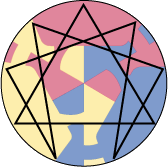
"...The original Optimized
Results logo came to me while meditating, around 1974, long before I
learned of the Enneagram. I was thinking about the three cores of
our being, (feeling, thinking, and sensory knowing) and how the balance
would create some form of perfection. If each had a dominant and
two recessives (my Dad is a biochemist) there would be three aspects of
the three cores of being. I painted my vision (my Mom is an
artist) in the three primary colors, each interlocking piece identical
and even, so that they would represent the total palette. One day
while studying the Enneagram I looked up at the painting on my wall, and
saw how it would fit, inscribed perfectly with each point of each triad
lining up within the shapes I had dreamed up so long ago. I had
never felt so in line with my destiny and my soul's work..."
******************************
"...You offered the material in a way that makes it immediately accessible and very valuable as a tool...an elegant and eloquent job of communicating the peacemaking possibilities of the Enneagram to the group!"
-Barbara Mark, Ph.D. Founder of Full Circle Institute
Past President, International Association of Coaches
******************************
"…I was very impressed with how quickly and easily Ian helped us systemize our methods and simplify our work, eliminating barriers to growth…"
--Jeff Dorais, General Manager - Eva's Draperi
******************************
"Ian’s coaching is exceptional in facilitating personal and organizational development, using his model of the Integral Enneagram. As a coach and consultant, he’s able to create rapport immediately through his ultra-creative and personable approach, generating insights and value drawn from his vast knowledge and ability to quickly get to the core issues. Highly, highly recommended for anyone who feels like they are spinning their wheels and can't get to the root cause."
-- Kris Surroy - Organizational Development Consultant & Social Entrepreneur
******************************
Although its
earliest origins are not completely clear, the symbol may have
originated in ancient Sufi traditions, and was studied
extensively by the esoteric Armenian teacher and philosopher
George Gurdjieff (1866-1949). Gurdjieff is commonly credited with
being the first to convert the Oral Tradition to a Written Tradition,
inviting the rest of the world to become familiarized. However,
neither the Sufis nor Gurdjieff, as far as documentation goes, taught a
system of “personality types.”
Gurdjieff saw the
Enneagram as being far more universally applicable. He felt that
the Enneagram was a universal symbol containing all knowledge, if one
was able to properly interpret. The Enneagram is a symbol that
illustrates dynamic shifts in the natural world. You can
illustrate the dynamic process of water evaporating, collecting in
clouds, condensing, precipitating, soaking into the Earth, flowing back
toward the oceans, and so forth with the Enneagram. The numbered
points that most people are familiar with are originally represented by
musical scale tones, and Gurdjieff describes the dynamic shifts in
Octaves.
The modern (and
popularized) version of the Enneagram of Personalities (also
known as Ego-Structure) emerged in the 20th century, from the Bolivian
psychologist Oscar Ichazo who was a student of Gurdjieff's work, but
whose personality system stands apart from Gurdjieff's teachings.
His own perspectives and filters excited his interest in the dynamic
shifts of personalities. Ichazo taught his system to a group of
followers in Arica, Chile, where one of his pupils, the Chilean
psychiatrist Claudio Naranjo, became a prominent Enneagram writer
and teacher.
Naranjo felt
strongly about the intersection of psychology and spirituality, and this
was the basis of his teachings, which he brought to the United States
around 1970. The Gestalt therapy of Fritz Perl and Karen Horney’s
self-psychology were also strong influences in Naranjo’s teachings.
A small group of students living in Berkeley with Naranjo were
responsible for the further changes to the Enneagram’s presentation over
the last few decades. Helen Palmer's book "The Enneagram,"
(HarperCollins, 1988) greatly popularized the Enneagram of Personality,
and perhaps added a bit more fuel to the rift between Naranjo and
Ichazo's Arica Institute. They spent a lot of time in litigation.
The current perception of the Enneagram of Personality has been
heavily influenced and controlled by Don Richard Riso, who took his
Jesuit studies of the Enneagram, and applied deep psychological theory
to elaborate and flesh out the descriptions of the "nine types,"
striving for a more positive view. (Personality Types: Using
the Enneagram for Self-Discovery, Houghton-Mifflin, 1987) Riso
espouses the "single dominant wing" theory, and what may be the most
important contribution to popular Enneagram theory: the Levels of
Development from unhealthy to healthy in psychological terms. By
introducing this third dimension to the knowledge-base, functionality
and applicability skyrocketed. The model began to look more like
stacked plates; each an Enneagram at a different Level, with parallel
developmental aspects.
Ian Blei was inspired by this three-dimensional concept, as the more
Gurdjieff-like model he had been working with since the 1970's required
other models to illustrate developmental growth. A core divergence
here was to not use psychotherapy as the basis of study (Ichazo,
Naranjo, Palmer, Riso) but to work with consciousness as a part of
"natural science," thus illustrated by Gurdjieff's and Ouspensky's
Universal Enneagram. This creates an enormous difference in
approach, as psychology works with what is called a "disease model,"
looking at what is wrong or unhealthy, and striving to fix it.
Consciousness uses a "wellness model," that looks at naturally available
resources, and how to maximize upon them. This lends itself more easily
to self-development, rather than being "fixed by a doctor." Around the world there are many, many brilliant schools of thought
that work with the more "spiritual" aspects of the Enneagram, and either
follow closely along the original Gurdjieff/Ouspensky model, or form
some level of hybrid with the psychological models. Perhaps one of
the most intense and well known is the Diamond Approach developed by
A.H. Almaas. The Ridwan Schools that follow this approach are
quite rigorous and can be a bit intimidating.
Another fundamental
Furthermore, rather than the inorganic parallel processing of Riso's model, each of the aspects of perspective in this model may develop independently of one another at their own altitudes, following Quantum Physics and natural phenomena such as meteorology. This meant that a synthesis of Integral Spirituality/Consciousness, Cognitive Linguistics and Hermeneutics, Spiral Dynamics, and various models of ascending consciousness could all fit within this Integral Enneagram. Thus a funnel-shaped 3-Dimensional model of the Enneagram that is incredibly accurate in its ability to illustrate the nuances of our consciousness, from all states, quadrants, and lines was born. Ian Blei named this new Integral Enneagram the Integram™ as a new and unique entity.
Perhaps most importantly, this model is able to create a tangible path toward balance and harmony of our internal components, and the intentional development of our consciousness. Part of the accuracy is due to eschewing behavioral observations for engagement and involvement, to center on motivation and fixation, as the original Jesuit writings touched upon, and then adapts Gurdjieff's internal "pentagram" of Centers.
Each of the Enneagram types has the unique gifts of the five types that comprise their "constellation" of perspectives. These gifts are what they contribute to the full spectrum of human potential. However, each gift has a dark side. Much like the yin-yang symbol, there is a little shadow in each gift and a little gift in each shadow.
Gifts and traits are certainly illuminated by the Integram™ as well as the Enneagram, but that is by no means the limit of its capabilities. We can't understand ourselves or others with a laundry list of observable traits, but as the study of Hermeneutics shows us, we can enter another person's worldview and understand what natural and social influences created their beliefs. The internal landscapes and self-talk that reveals them give us such a powerful use of the Enneagram. We can go beyond walking in someone's shoes and see the world through their eyes. The Enneagram shows us a model of Nine co-existing "truths." One does not have to be wrong for another to be right, and this is the beginning of all conflict resolution, and all compassion in the world.
Optimized Results uses this philosophy and approach to improve the effectiveness of communication, and the quality of relationships. When we can truly see how each of us views the world, and how that impacts our communication, we can begin communicating with one another, rather than talking at one another.
Quick Link to Descriptions of the Types
Home | Site Map | Terms of Use | Newsletter | Contact | Services
Privacy Policy | How It Works | About Us | Success Stories | Resources | Podcasts
© 2001- 2026 Optimized Results. All Rights Reserved 205 Chattanooga St. San Francisco, CA 94114 415.826.0478
